Matz and Schramm Families - Person Sheet
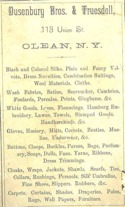
NameHenry Richard Dusenbury 
Birth5 May 1801, Hancock, Delaware County, New York
DeathJun 1860
BurialChestnut Hill Cemetery, Portville, New York
OccupationStarted Lumber Business, Dusenbury, Wheeler, May & Co. In Portville, NY 1834
FatherJohn Dusenbury (1773-1856)
MotherRuth Sands (1771-1812)
Spouses
Birth1811, New York
DeathFeb 1871
BurialChestnut Hill Cemetery, Portville, New York
FatherColonel Samuel Butler
MotherElizabeth Pine (Pyne?)
Marriage16 Jul 1828, Deposit, New York
ChildrenCatherine Butler (1830-1916)
Sarah Elizabeth (1832-1909)
Henry (ca1834-1856)
John Edgar (1836-1913)
William Addison (1839-1890)
Edgar Gregory (1841-1920)
Caroline (1846-1933)
Notes for Henry Richard Dusenbury
His father moved the family moved to Windsor, Broome County in 1815.
“of Windsor” at time of marriage July 1828.
Henry moved to Deposit in 1828.
With wife, moved to Portville, NY, 1834.
At Olean, New York at time of father’s death in August 1856.
Started with mill and 1500 acres at Portville, later added store, additional land in western NY and eastern PA, ran timber down Ohio and Allegheny Rivers.
Letter in 1925 on letterhead of Wheeler & Dusenbury, Endeavor, PA est. 1834 refers to first ledger in Deposit, NY of Dusenbury, Wheeler & Co. June 12, 1818.
Origins of lumber business, from website of Soper-Wheeler Co, California 2003:
1792-’94 William ‘Deacon Bill’ Wheeler and his three brothers move from their parent’s home in New London, Connecticut to Hancock, New York, a small town on the East Branch of the Delaware River. There, at Partridge Island, they purchase 1,500 acres of pine timberlands and build a dam and sawmill. The pine is rafted down the Delaware River to the markets of Philadelphia.
1813 The Wheelers move upriver to the town of Deposit, New York on the West Branch of the Delaware River. There they build a dam and sawmill that they operate for the next twenty years as part of their varied lumbering activities along the Delaware River. Deposit’s name is derived from the practice of rafters who ‘deposited’ surplus personal belongings there before continuing their trip downriver to Philadelphia. The Wheelers become friends and business associates with the Dusenbury family who owns a large mercantile house in Deposit.
1834 William Wheeler, his son William F. Wheeler, Henry Dusenbury, Erza May, Edgar Gregory, and Russell Kelsey form a timber business called Dusenbury, Wheeler, May and Company. They purchase 1,500 acres of timberlands and build a sawmill at Dodge Creek near what is now Portville, in western New York State. William F. Wheeler moves to Portville where he organizes the business and manages the sawmill. Lumber is rafted down the Allegheny River to the markets in Pittsburgh. Henry Dusenbury moves to Portville where he builds and operates the company store.
1837 William F. Wheeler and Henry Dusenbury establish a new firm called the Wheeler and Dusenbury Lumber Company and purchase 4,000 acres of timberlands located on Tionesta Creek in Venago, now Forest County, in northwestern Pennsylvania. The company also purchases a sawmill, along Tionesta Creek known as Siverly Mills, later renamed Newtown, and is located about fifteen miles upstream from the Allegheny River. For the next several years the business is conducted without turning a profit, nonetheless, the company continues to purchase adjacent timberlands.
1850 A second sawmill is acquired by the Wheeler and Dusenbury Lumber Company. This ‘double mill’, which had both a single saw and a gang saw, was located in Stowtown, Pennsylvania. For a short time the Stowtown is called Rialto but in 1897 it is officially renamed - Endeavor. The town’s name is derived from a local religious organization called the Christian Endeavor Society of Stowtown.
1850-1865 The Wheeler and Dusenbury Lumber Company purchases thousands of acres of Pennsylvania timberlands in Forest and Warren Counties. The milling operations are centered in Newtown.
1860 Henry Dusenbury dies. William Dusenbury, Henry’s son, takes over the family business.
http://www.soperwheeler.com/main/timeline.asp
“of Windsor” at time of marriage July 1828.
Henry moved to Deposit in 1828.
With wife, moved to Portville, NY, 1834.
At Olean, New York at time of father’s death in August 1856.
Started with mill and 1500 acres at Portville, later added store, additional land in western NY and eastern PA, ran timber down Ohio and Allegheny Rivers.
Letter in 1925 on letterhead of Wheeler & Dusenbury, Endeavor, PA est. 1834 refers to first ledger in Deposit, NY of Dusenbury, Wheeler & Co. June 12, 1818.
Origins of lumber business, from website of Soper-Wheeler Co, California 2003:
1792-’94 William ‘Deacon Bill’ Wheeler and his three brothers move from their parent’s home in New London, Connecticut to Hancock, New York, a small town on the East Branch of the Delaware River. There, at Partridge Island, they purchase 1,500 acres of pine timberlands and build a dam and sawmill. The pine is rafted down the Delaware River to the markets of Philadelphia.
1813 The Wheelers move upriver to the town of Deposit, New York on the West Branch of the Delaware River. There they build a dam and sawmill that they operate for the next twenty years as part of their varied lumbering activities along the Delaware River. Deposit’s name is derived from the practice of rafters who ‘deposited’ surplus personal belongings there before continuing their trip downriver to Philadelphia. The Wheelers become friends and business associates with the Dusenbury family who owns a large mercantile house in Deposit.
1834 William Wheeler, his son William F. Wheeler, Henry Dusenbury, Erza May, Edgar Gregory, and Russell Kelsey form a timber business called Dusenbury, Wheeler, May and Company. They purchase 1,500 acres of timberlands and build a sawmill at Dodge Creek near what is now Portville, in western New York State. William F. Wheeler moves to Portville where he organizes the business and manages the sawmill. Lumber is rafted down the Allegheny River to the markets in Pittsburgh. Henry Dusenbury moves to Portville where he builds and operates the company store.
1837 William F. Wheeler and Henry Dusenbury establish a new firm called the Wheeler and Dusenbury Lumber Company and purchase 4,000 acres of timberlands located on Tionesta Creek in Venago, now Forest County, in northwestern Pennsylvania. The company also purchases a sawmill, along Tionesta Creek known as Siverly Mills, later renamed Newtown, and is located about fifteen miles upstream from the Allegheny River. For the next several years the business is conducted without turning a profit, nonetheless, the company continues to purchase adjacent timberlands.
1850 A second sawmill is acquired by the Wheeler and Dusenbury Lumber Company. This ‘double mill’, which had both a single saw and a gang saw, was located in Stowtown, Pennsylvania. For a short time the Stowtown is called Rialto but in 1897 it is officially renamed - Endeavor. The town’s name is derived from a local religious organization called the Christian Endeavor Society of Stowtown.
1850-1865 The Wheeler and Dusenbury Lumber Company purchases thousands of acres of Pennsylvania timberlands in Forest and Warren Counties. The milling operations are centered in Newtown.
1860 Henry Dusenbury dies. William Dusenbury, Henry’s son, takes over the family business.
http://www.soperwheeler.com/main/timeline.asp